

How to choose a Trybe brand before you start filming
A practical way to compare program terms, product fit and public evidence before spending your next filming session on a brand.
There is a useful question to ask before you choose a Trybe brand: what would make this a sensible use of your next filming session? A headline commission rate cannot answer that on its own. You also need to know whether you can make a convincing video for the product, what the program actually requires, and which parts of the brand's activity you can verify.
Trybe's public overview describes creator programs built around content submissions and performance-based earnings. That makes the program's conditions central to the decision. A brand accepting creators, approving a video, using a video in an ad and reporting a payment are different events. Treat them separately when you plan your work.
Start with a product you can explain
Open the brand's products before you open your camera. Can you show the actual item, demonstrate a useful feature, and explain who it is for without borrowing claims you cannot support? A good fit might come from an item you already own, a category you understand, or a routine you can film clearly. A recognizable brand name alone is a weak reason to choose it.
The brand directory lets you narrow the research by category and payment model. Use those filters to make a manageable shortlist rather than trying to evaluate every program. Then open each brand page and check the product names and the full program description. Similar brand names can hide very different products and expectations.
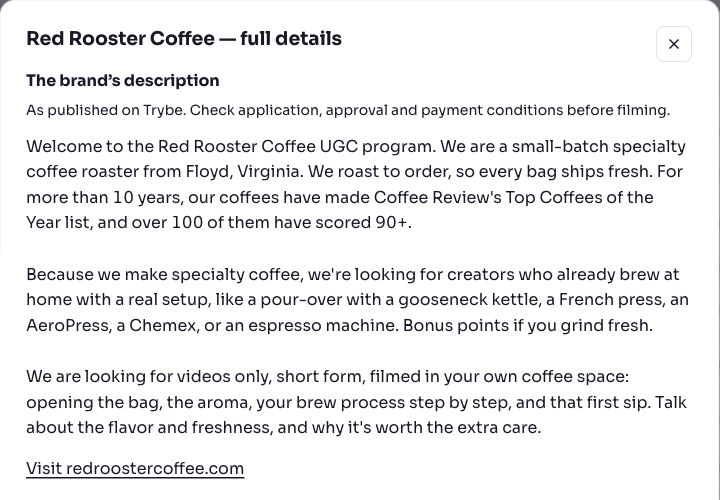
Consider Red Rooster Coffee's brand page as an example of reading for fit. Its public program description shown below asks for short videos in a creator's own coffee space and describes a real brewing setup. That is a more useful clue for a coffee creator than a percentage by itself. The screenshot is an archived example, not a promise that today's program has identical terms.
Translate the payment headline into conditions
Read the full description even if the summary looks attractive. Write down what must happen for the offered payment to apply. Does it depend on attributed sales, ad spend, a specified approval, or a separate agreement? Is there a cap? Is a sample available, required, or something you would buy yourself? If those details are missing, ask before you assume.
This comparison is a planning aid, not a prediction of what you will earn:
| Headline you see | Question to answer before filming |
|---|---|
| Percentage of sales | Which sales count, what is the attribution rule, and are there limits? |
| Percentage of ad spend | What qualifies, and is there any commitment to use your content? |
| Per approved submission | What counts as approved, and are there volume or eligibility conditions? |
| A retainer or custom offer | Where are the deliverables, usage and payment conditions written down? |
Avoid mentally turning a percentage into a guaranteed fee. A high rate with an uncertain qualifying event may be less suitable for your situation than a clearly specified offer. Likewise, a published payout schedule describes timing under the program's conditions; it does not establish that your next submission will qualify.
TrybeDaily's guide to choosing a brand explains where to find these fields in the interface. For the final check, follow Open on Trybe and read the version of the program available to your account. A saved screenshot is useful for your records, but it cannot confirm that terms have stayed the same.
Separate evidence from expectation
Use public observations to ask better questions. A dated creator count, a public payout tier or recent observed content can show that something is happening around a brand. None of those fields tells you your own approval odds or your future income. Missing reported payout information is also not evidence that the brand has never paid anyone.
When comparing examples, open the actual video and inspect what the creator featured. Look for a useful demonstration, a clear problem or a relevant audience. Take notes on the approach rather than copying the script or treating visible engagement as proof of earnings. TrybeDaily's daily page is a starting point for research; the original source and its date still matter.
If you already posted about a product, use that as a separate research question: is the brand on Trybe, and does your existing content fit its current requirements? A TikTok product match helps locate a possible program. It does not mean the program has approved that video. Our article on why TikTok matches go missing explains how to check that distinction.
Make a small, deliberate filming decision
Pick one program only after the product, conditions and evidence make sense together. Define the first video you would make: the item, the viewer's problem, the demonstration and the question you expect it to answer. If you need clarification, use the program's chat or the brand's published creator contact before investing in a large batch.
Decide how much time and out-of-pocket cost you are comfortable committing while outcomes remain uncertain. Record the program terms you checked, the date, the question you asked and the next action. This keeps a vague opportunity from becoming an open-ended obligation. Our article on choosing the right contact can help you avoid sending that clarification to a customer-service or research inbox.
Before publishing commercial content on TikTok, review TikTok's content disclosure instructions. TikTok says its disclosure setting is required when promoting a brand, product or service. Check the current instructions for the kind of content you are posting.
The practical result should be simple: you can explain why this product fits, which conditions you still need to satisfy, and what you will do next. If one of those answers is missing, more research is usually more useful than another take.