
Trybe payment models explained: commission vs ad spend vs flat fee
How commission, ad spend and flat fee programs on Trybe pay creators, when each one is earned, the risks of each, and how to compare them fairly.
Quick answer
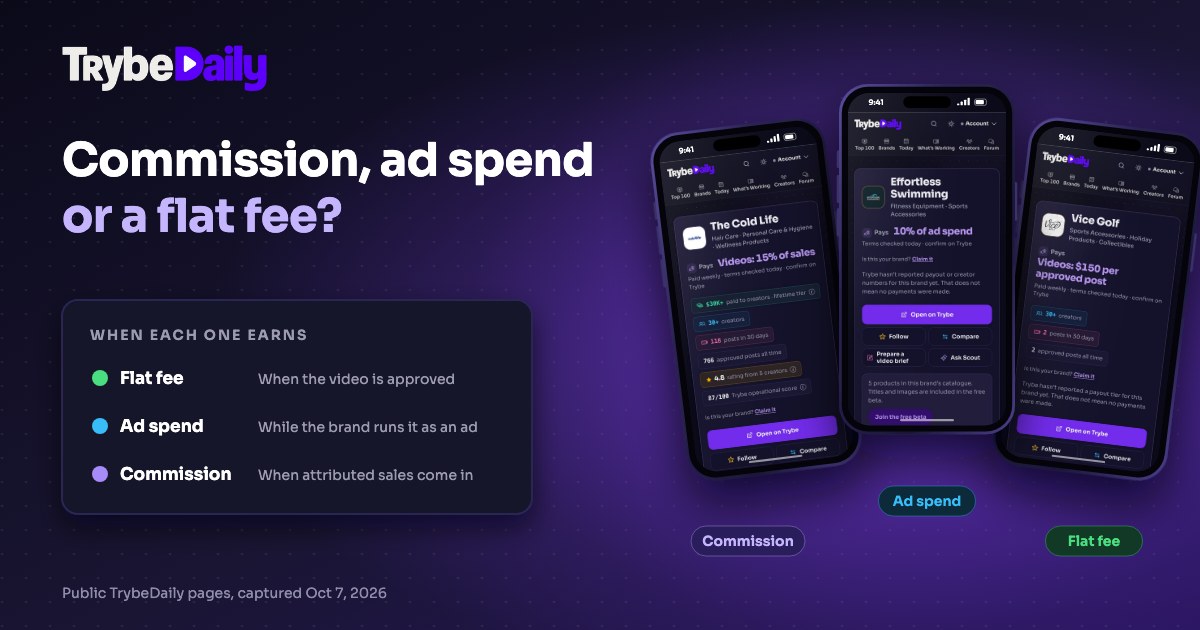
A flat fee pays once a video is approved. A commission pays a share of attributed sales, and an ad spend program pays a share of what the brand spends running your video as an ad. Compare programs on what has to happen before each one pays, and on caps and schedules, not on the headline number.
Every Trybe program pays on a basis: a share of sales, a share of ad spend or a fixed fee. Comparing a commission with a flat fee is not like comparing two prices. Each model pays for a different event, at a different time, with a different risk.
This guide explains each model, how the money arrives and how to compare programs that pay in different ways.
Key takeaways
- A flat fee pays for an approved video. A commission pays for attributed results such as sales or ad spend.
- Trybe's Creator Terms say flat fees are earned on acceptance and commissions accrue as attributable results occur.
- Commission and ad spend programs can pay more for a strong video, and nothing for a video that never runs or sells.
- Compare programs on what has to happen before they pay, not on the headline number.
- Caps, refunds and schedules change what a rate is worth in practice.
TrybeDaily is an independent research site and is not affiliated with Trybe. This guide summarizes Trybe's public pages and terms as we read them on October 7, 2026. Always check the current program and terms on Trybe before you rely on them.
The three payment models at a glance
Trybe's homepage groups creator pay into sales-based commissions, ad performance commissions and flat-rate payments. Here is how they compare.
| Question | Commission on sales | Ad spend | Flat fee |
|---|---|---|---|
| What you are paid on | A percentage of attributed sales, or a fixed amount per order | A percentage of what the brand spends running your video as an ad | A fixed amount for each approved video |
| When it is earned | As attributable sales occur | As ad spend on your content is recorded | When the video is accepted |
| What has to happen first | People buy through your content | The brand runs your video as a paid ad | The brand approves or uses the video |
| Upside | Grows with sales, up to any cap | Grows with ad budget, up to any cap | Fixed |
| Main risk | Few or no attributed sales | The video is never run, or runs briefly | Rejection |
| Brands using it as the headline term, October 7, 2026 | 4,546 (including 117 per order) | Part of 1,075 ad-based programs | 527 |
The last row comes from TrybeDaily's public brand data for October 7, 2026, which covered 6,148 brands. Many programs combine more than one model, so treat these counts as a dated snapshot.
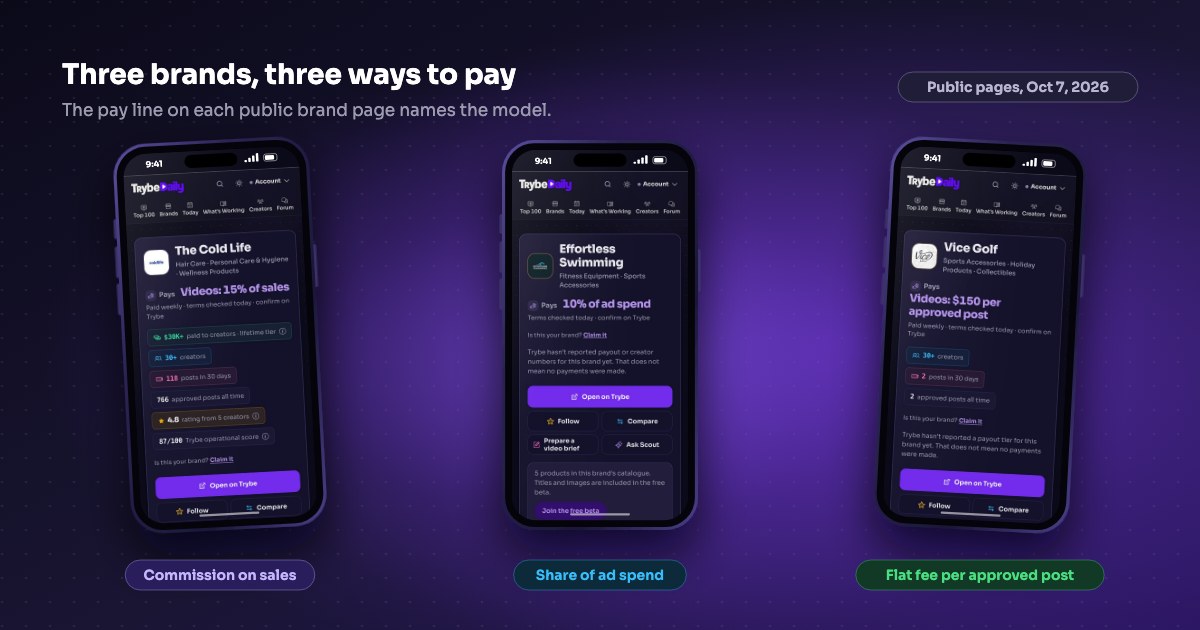
The image below shows one brand per model as listed on October 7, 2026: The Cold Life paid a share of sales, Effortless Swimming a share of ad spend, and Vice Golf a flat fee per approved post. Vice Golf has not appeared in TrybeDaily's brand list since October 8, 2026.


Commission on sales
A sales commission pays a percentage of sales attributed to your content. Trybe often labels this as a percentage of GMV, which means gross merchandise value. Some programs instead pay a fixed amount per qualifying order.
How earnings arrive
Trybe's Creator Terms, effective February 20, 2026, say commissions accrue when attributable results occur under the program's rules and attribution method. Brands are charged at least monthly and the commission is passed on to creators.
That means income can keep arriving long after you post, for as long as the content keeps selling and the program runs.
Risks to check
Attribution decides what counts, so read how the program tracks sales. The terms allow earned commissions to be adjusted for confirmed fraud, refunded or cancelled orders, and chargebacks where the program lists them.
On October 7, 2026, the median published sales rate among the 4,429 brands using it as the headline was 12%, and 10% was the most common.
Ad spend
Ad spend programs pay a percentage of what the brand spends promoting your video as a paid ad. Trybe's brand terms say attribution can use data from the brand's connected ad accounts.
How earnings arrive
You earn while the brand is spending on your content. If the brand scales a video, earnings scale with it, up to any cap.
If the brand never runs your video as an ad, an ad spend rule pays nothing on it. Some programs pair an ad spend rule with a small flat fee so that approval alone pays something.
Risks to check
You do not control the budget, and a brand can pause an ad at any time. Ask how the brand decides which videos to run and for how long.
Among the 500 brands with an active ad spend rule on October 7, 2026, the median and most common rate was 10%. Some ad-based programs pay on other measures instead, such as a percentage of ad-attributed sales or an amount per purchase.
Flat fee
A flat fee pays a fixed amount for each approved video, regardless of how it later performs. Trybe shows these as an amount per submission.
How earnings arrive
The Creator Terms say a flat fee is earned on acceptance, which happens when the brand approves the content or uses it in marketing, whichever comes first. Payment then follows the schedule in the program details.
A rejected video is not paid unless the program says otherwise. You keep the rights to rejected content under those terms.
Risks to check
The risk is approval, so read the brief closely and ask before filming if anything is unclear. There is no upside if the video goes on to sell well, unless the program adds a commission.
On October 7, 2026, 436 flat-fee brands paid in US dollars. Their median fee was $50 per approved video.
How to compare commission vs flat fee
Turn each program into the same three questions:
- What event pays? Approval, a sale, an order or ad spend.
- How likely is that event for this product and your content? Be honest about your approval history and audience.
- What limits apply? Caps per submission or per order, exclusions, refunds and the payout schedule.
An illustrative comparison, with invented numbers that do not describe any brand:
| Hypothetical program | Result for one video | Before caps and adjustments |
|---|---|---|
| $40 flat fee | Approved | $40 |
| 10% of sales | $250 of attributed sales | $25 |
| 10% of ad spend | Brand spends $600 on the ad | $60 |
| 10% of ad spend | Video approved but never run | $0 |
The same video lands differently under each model. Which is better depends on events you can only estimate.
When each model tends to suit
- A flat fee suits you when your approval rate is good and you want predictable pay per video.
- A sales commission suits products you can demonstrate convincingly to an audience likely to buy.
- Ad spend suits brands that clearly run creator videos as ads, where you can learn how they pick winners.
Other terms that change the value of a rate
A few details can matter as much as the headline:
- Caps. 474 brands had a cap on at least one active rule on October 7, 2026.
- Rate locks. The Creator Terms say your commission rate in a program cannot be reduced once you are added to it, though a brand can open a new program with different rates.
- Payout schedule. Of the 5,021 brands stating a schedule that day, 4,835 said weekly.
- Minimum payouts. The terms allow a minimum payout threshold, with smaller amounts carried to the next cycle.
Our Help guide to Trybe payment models and program caps has more on caps, and the guide to payment tiers explains why a brand's payout total is not a rate.
Short answers
Is a flat fee safer than a commission?
It is more predictable once a video is approved. It also caps what one video can earn, so it is a trade rather than a strictly safer choice.
Can a program pay both a flat fee and a commission?
Yes. Some programs combine a flat fee with a sales or ad spend rule. Read each rule and its cap separately.
Where do I check what I was actually paid?
On Trybe's Payouts screen. Our article on where to find your Trybe earnings explains each figure.
Sources
- Trybe: homepage describing sales, ad performance and flat-rate payments
- Trybe Creator Terms of Use, effective February 20, 2026
- Trybe Brand Terms of Service, effective August 8, 2026
- TrybeDaily: all brands and their published terms
- TrybeDaily Help: Comparing Trybe payment models and program caps
- TrybeDaily Help: What do payment tiers mean?
Brands mentioned
Each brand page shows current payment terms, products and example videos. Pay terms as listed on November 24, 2026. Confirm the terms on Trybe before you film.
- The Cold LifeVideos: 15% of salesHair Care
- Effortless Swimming15% ad spendFitness Equipment
About this article
Written by the TrybeDaily team and published . Sources are listed above. TrybeDaily is an independent research site, separate from Trybe. Always confirm current program terms in Trybe.
Next steps on TrybeDaily
- Browse the brand directoryFilter Trybe programs by category and payment model.
- See today's brandsA daily, dated starting point for research.
- Help: choosing a Trybe brandWhere each program field lives.